

Taxonomy
- Kingdom: Animalia
- Phyllum: Chordata
- Class: Mammalia
- Order: Carnivora
- Family: Ursidae
- Genus: Helarctos
- Species: Helarctos malayanus
oName
- Scientific name: Helarctos malayanus.
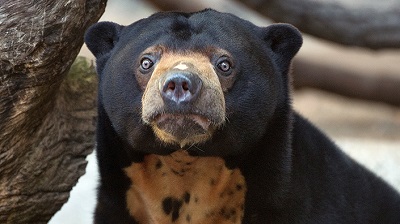
- Common name: Honey bear, sun bear. Named for its distinctive sun like colored chest patch.
Distribution and Habitat
- Its range covers the countries of Bangladesh, Brunei, Cambodia, China, India, Indonesia, Laos, Malaysia, Myanmar, Thailand and Vietnam.
- Its habitat is greatly fragmented due to deforestation and according to the IUCN Red List of Threatened Species its population has declined by more 30% over the past 30 years.
- Sun bears inhabit lowland dense tropical forests where there is plenty of food and cover.

♦ – Extinct ♦ – Extant or resident ♦ – Probably extant or resident
Physical Features
- Sun bears are the smallest of all existing bear species.
- Males are up to 20% larger than females. Adults measure 47 to 59 in or 1.2 to 1.5 m and weight from 60 to 143 lb or 25 to 65 kg.
- Its tail is 1.2 to 2.8 in or 3 to 7 cm long.
- The sun bear has an exceptionally long tongue which measures 7.9 to 9.8 in or 20 to 25 cm. It helps them extract ants, termites and honey from deep cavities.
- It has a thick black brown undercoat with lighter guard hairs and a golden colored crescent-shaped patch on the chest.
- Sun bears have a stocky build, short muzzle, large paws and strongly curved and pointed claws.
Behavior
- They can be both nocturnal and diurnal. When their habitat is affected by human activity they are more active at night to avoid confrontation.
- They are solitary animals and the only times they are not alone is when looking for a mate and when raising cubs. They have been seen congregating around sources of food and tolerate one another when feeding.
- Sun bears spend their days resting under fallen logs or in their cavities or on a platform made out of vegetation up on the tree canopy. They are the most arboreal of all bear species.
- They are very agile and are skillful climbers.
- Because food is available throughout the year they do not need to hibernate.
- Like all other bear species sun bears have an acute sense of smell.
Reproduction
- Sun bears reach reproductive maturity between 3 and 4 years old.
- Mating may occur at any time of the year.
- Females build their birthing sites under fallen trees or in hollow cavities.
- Gestation lasts from 90 to 110 days as reported in zoos. When there is delayed implantation gestation lasts an average of 214 days.
- Litter size is 1 to 2.
- Cubs are born hairless and blind and with a weigh of about 10oz or 280 gr. Their eyes open at around 30 days.
- They stay with their mother for 18 months.
Diet
- Sun bears are omnivorous.
- They eat termites, ants, earthworms, bees, honey and fruits.
- They prey on birds, reptiles, small mammals and eggs.
Life Expectancy
- They can live more than 30 years in captivity.
- In the wild it is estimated that they can live for an average of 25 years.
Predators
- Because of their size sun bears have no known predators other than humans.
- Cubs are more vulnerable to become prey to tigers, snakes and large birds.
Threats
- Poaching and killing of sun bears for their body parts which are used in traditional medicine.
- Habitat destruction and fragmentation due to deforestation, road building, oil and mining exploration.
- The killing of bears to avoid crop and cattle destruction.
Conservation Status
- Reliable information about populations is not available however there is a strong evidence of its declining trend.
- Sun bear is listed under Appendix I of CITES.
- The IUCN Red List of Threatened Species lists the sun bear as a vulnerable species.
Related Species
 |
 |
 |
 |
| Bear, Andean or Spectacled |
Bear, Asiatic Black |
Bear, Black | Bear, Brown |
 |
 |
 |
 |
| Bear, Giant Panda | Bear, Polar | Bear, Sloth | Bear, Sun |
References and further research
World Association of Zoos and Aquariums – Malayan sun bear
University of Michigan Museum of Zoology – Helarctos malayanus sun bear
Stability of Altered Forest Ecosystems – Sun bear (Helarctos malayanus)
American Society of Mammalogist – Mammalian Species Helarctos malayanus
IUCN Red List of Threatened Species – Helarctos malayanus
The Animal Aging and Longevity Database – An age entry for Helarctos malayanus