
o
o
Name
- Scientific name: Megaptera novaenanglia. Megaptera is derived from the Greek mega for “large” and pteron for “wing”. Novaeangliae for New England where the humpback was first described scientifically.
- Common name: Humpback whale, hump whale, hunchbacked whale.
Conservation Status
- The humpback whale is listed as Least Concern by the IUCN. Its status was changed from Vulnerable to Least Concern in 2008. Up to 1988 it was listed as Endangered.
- They are designated as “Endangered” by the Endangered Species Act (ESA).
- It is listed in Appendix I of CITES and the Convention on Migratory Species of Wild Animals.
- Humpback whales have been protected from commercial whaling since 1966 by the International Whaling Commission.
Distribution and Population
- Humpback whales are found in all oceans around the world.
- According to the IUCN the current worldwide humpback population is estimated at over 60,000 animals and its population trend in increasing.
- There are 4 populations of humpback whales: North Atlantic, North Pacific, Northern Indian Ocean, and Southern Hemisphere.
Habitat
- During the summer they migrate to higher latitudes near the poles to feed. In winter they migrate to tropical and subtropical waters to breed and give birth.
- Southern hemisphere whales congregate in the Antarctic during the summer and in the winter they migrate to near shore breeding areas north of the equator.
- Northern hemisphere humpbacks migrate north towards the Bering Strait and Greenland Sea and south during winter to around 40˚
- Calving grounds are located offshore near islands, continental shelf or reefs.

Physical Features
- Females are larger than males.
- Humpbacks have long streamlined bodies.
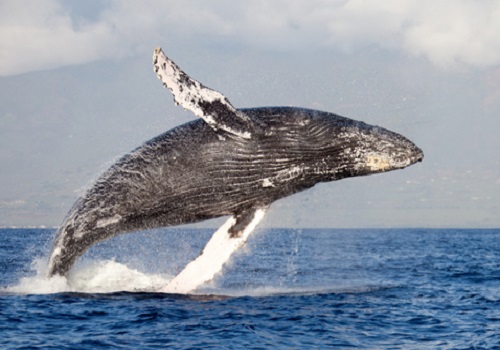
- Head and lower jaw are covered by knobs called tubercles.
- They have long pectoral fins that can be up to 15 feet (4.6 meters) long and are proportionally the longest of any cetacean.
- Their skin is dark grey with white in the belly and pectoral fins. This coloring pattern is unique in each individual which makes them recognizable to researchers.
- They have ventral grooves that run from the lower jaw to about half way of its body.
- Their flippers are long and can be almost 30% of its body length.
- Its dorsal fin has a hump shape, therefore its name “humpback whale”.
Weight and Length
- Humpback whales weigh from 50,000 to 80,000 lb (22,000 to 36,000 kg) and are up to 60 feet (18 meters) long.
Migration
- Humpback whales have the longest migration of any mammal, traveling as far as 5,160 miles (8,300 km).
- Migration is related to feeding and reproduction.
- During summer they spend their time feeding and building up fat reserves which they will need for the winter. Southern hemisphere humpbacks congregate in the Antarctic while Northern hemisphere ones gather in sub Arctic waters.
- In the winter humpbacks mate in tropical and subtropical waters north of the Equator.
- Migration takes place in deep waters.
Behavior
- A group of whales is called a pod which can contain as many as 15 individuals. Membership in the pod is short lived.
- The longest association in a pod is between a cow and a calf. They remain together for a year during which period she nurses and teaches the calf to hunt for food.
- Among hunting methods used by humpbacks are “bubble netting” performed to distract and disorient fish.
- Males sing songs that can last up to 20 minutes, scientists still do not understand its function but may be to communicate with other males or to attract females.
- Every season they return to the same breeding and feeding grounds.
- One of its most recognizable behaviors is the breach where the humpback leaps lifting almost its entire body out of the water. Breaching also involves twisting sideways.
Diet
- Krill, plankton, fish.
- They can consume up to 3,000 lb (1,360 kg) of food a day.
Reproduction
- Female humpbacks reach reproductive maturity at age 5 while males at age 7.
- Breeding season is during winter when whales congregate in tropical and subtropical waters.
- The breeding cycle of humpbacks is every two years.
- Gestation period is 11 to 11.5 months and number of offspring is 1.
- Calves are born in warm tropical and subtropical waters in either hemisphere.
- The young depend on their mothers’ milk for the first 5 months.
Life Expectancy
- Its maximum longevity is 95 years in the wild.
Threats
- Accidental by catch in fishing nets.
- Sea pollution.
- Subsistence whale catches.
- Oil and gas exploration.
- Ship strikes.
- Recovery of population is slow as the breeding cycle is every 2 years.
- Climate change may impact availability of food .
Taxonomy
- Kingdom: Animalia
- Phylum: Chordata
- Class: Mammalia
- Order: Cetartiodactyla
- Family: Balaenopteridae
- Genus: Megaptera
- Species: Megaptera novaeangliae
References and further research
⇒The Animal Aging and Longevity Database – An age entry for Megaptera novaeangliae
⇒IUCN Red List of Threatened Species – Megaptera novaeangliae
⇒The International Whaling Commission
⇒University of Michigan Museum of Zoology – Megaptera novaeangliae
⇒National Oceanic and Atmosphere Administration – Megaptera novaeangliae
⇒U.S. Fish and Wildlife Service – Humpback Whale
⇒Royal Society – Global diversity and oceanic divergence of humpback whales (Megaptera novaeangliae)
⇒Smithsonian National Museum of Natural History – Megaptera novaeangliae
⇒World Register of Marine Species – Megaptera novaeangliae
⇒Marine Species Identification Portal – Megaptera novaeangliae
⇒Convention on the Conservation of Migratory Species of Wild Animals