
0
Taxonomy

- Kingdom: Animalia
- Phylum: Chordata
- Class: Mammalia
- Order: Artiodactyla
- Family: Giraffidae
- Genus: Giraffa
- Species: Giraffa camelopardalis
Name
- Common name: Giraffe.
- The name giraffe comes from the Arabic “zarafa” which means fast walker.
- Scientific name: Giraffa camelopardalis
0
Distribution and Habitat
- Their habitat extends from Chad in the north to South Africa in the south and from Niger in the west to Somalia in the east.
- Giraffes inhabit the grasslands, savannas and woodlands of South Saharan Africa.
- There are 9 subspecies of giraffes distinguished by their coat pattern.
- Giraffes are native from the African continent and their scientific name is Giraffa camelopardalis.

Physical Features
- Their legs are 6 ft or 1.8 m long. Their back legs appear shorter than their front legs but they are the same length.
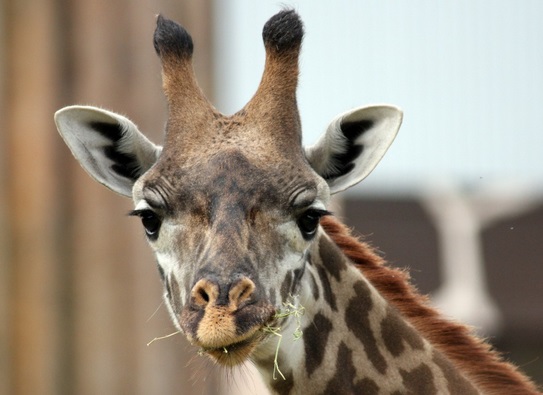
- Giraffe “horns” are actually called ossicones and are formed from ossified cartilage covered with skin. The ossicones of females and the young are thin with hair on top. Adult male ossicones end in knobs with no hair on top.
- A hump in the front of the skull is more prominent in males than females.
- Male giraffes use their long necks as weapons.
- Giraffes have spotted coats. Just like with fingerprints, no two individuals have exactly the same pattern but giraffes from the same area appear similar. Their patches can be orange, brown or black.
- Their coat serves as camouflage against predators. When a giraffe stands among trees they can barely be seen.
- Their tongues measure around 18 inches or 45 centimeters allowing them to feed on trees that are impossible for other animals to reach, such as thorny acacias. The color of their tongues is purplish- black with a pink back.
Size and Weight
- The giraffe is the tallest mammal on earth. A fully grown giraffe measures from 16 to 20 feet or 5 to 6 meters tall. Males are taller than females.
- Male giraffes weight an average of 2,628 lbs or 1,192 kg. Females weight an average of 1,825 lbs or 825 kg.
Diet
- Giraffes are herbivores and feed mostly of acacia leaves. They can eat up to 75 lbs or 34 kg of leaves a day.
- Their tongues measure 18 inches or 45 centimeters and is covered with a thick layer of papillae which allows them to remove the thorny leaves of the acacia trees.
- These animals need to drink once every several days, they get water from the leaves they eat. In order to drink water and reach the ground a giraffe has to awkwardly spread its front legs or kneel.
- Giraffes are chewing on leaves most of the time for 16 to 20 hours every day.
Social Behavior
- Male and female giraffes without calves do not have strong social bonds but will gather with others. A group changes members constantly even every few hours.
- Giraffes are not territorial but live in a territory range.
- The most visible groups are female giraffes with their calves. They gather together forming “calving pools” to protect their young against predators. They will watch each other’s calves while looking for food.
- In order to get the attention of a female sometimes male giraffes would fight each other using their necks.
Predators
- Their main predators are lions, wild dogs, leopards, hyenas and crocodiles.
- Giraffes defend themselves against predators by kicking with their long legs. They also run at a speed of 35 mph or 56 km/h for short distances.
- About 75 to 50% of calves are prey to predators.
Breeding
- The average gestation period for a giraffe is 15 months (453 to 464 days).
- Giraffes give birth usually to one calf but sometimes they have twins. Because giraffes give birth while standing up, their newborns have to fall almost 5f or 1.5m to the ground. The umbilical cord breaks while the newborn drops to the ground.
The young
- A baby giraffe is called a calf.
- A newborn is 6ft or 1.8m tall, within 1.5 hours after being born a calf can stand up and after 10 hours they can run with their mothers.
- For the first 1 to 3 weeks calves spend their time hiding.
- Mothers gather in nursery herds called “calving pools”.
Life Expectancy
- Giraffes can live from 20 to 25 years in the wild. A 25 to 50% of giraffes reach adulthood.
- In captivity they can live up to 28 years.
Conservation Status
- The giraffe is a protected species in Africa.
- The IUCN Red List of Threatened Species have listed giraffes as a “least concern” species. However, two subspecies, the West African Giraffe and the Rothchild Giraffe have been classified as endangered.
- Gaining a better understanding of giraffe behavior will help to develop more effective conservation strategies for improving giraffe management in the wild and in captivity by creating species-tailored management plans.
Did you know?
- Giraffes sleep for 15 to 30 minutes every day in intervals of a minute or two.
- Giraffes sleep standing up but can also lie down and rest their heads on their rump.
- No two individuals have the same spotted coats.
Sources:
University of Michigan Museum of Zoology – Giraffa camelopardalis, giraffe
Giraffe Conservation Foundation
IUCN Red List of Threatened Species
BMC Research Notes – Behavioral Inventory of the Giraffe (Giraffa Camelopardalis)