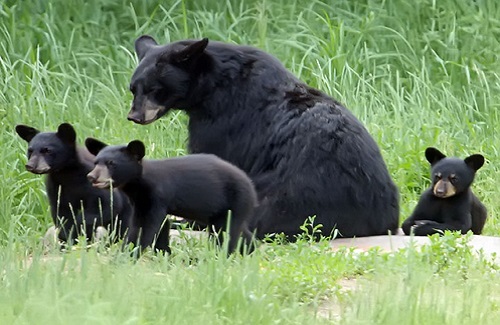
Taxonomy
Kingdom |
Phylum |
Class |
Order |
Family |
Genus |
Species |
| Animalia | Chordata | Mammalia | Carnivora | Ursidae | Ursus | Ursus Americanus |
0

0
Name
- Scientific name: Ursus Americanus.
- Common name: American black bear, Olympic black bear.
Physical Features
- The black bear is the smallest of the North American bears. The other North American bears are the grizzly or brown bear (ursus arctos) and the polar bear (ursus maritinus).
- They have non-retractable inch long claws that give them the ability to climb trees.
- Females have thinner and more pointed faces than males. Males are larger than females.
- They have small rounded ears.
- Black bears do not have shoulder hump like the brown bear.
- They have soft fur and a dense and thick underfur.
- Not all black bears are black. Black fur is more common in the east coast while western populations can be brown, cinnamon, blue gray or blond.
- They have strong muscles and can run at speeds of up to 30 mph or 50 km/hr.
- Black bears have a keen sense of smell. They have better eyesight and hearing than humans.
Habitat and Distribution
- The black bear is North America’s most common bear with the broadest distribution.
- It is distributed through most of Canada except for the prairies and Prince Edward Island. Its distribution also covers parts of the United States and the northern part of Mexico where it is rarely seen.
- Its habitat is very variable. They are found primarily in temperate and boreal forest but they can also inhabit subtropical areas such as Florida and northern Mexico.
- They inhabit tree covered areas and meadows, mountainous areas, sparsely populated woodland, swamps and forests.

Black bear distribution map. Source: IUCN Red List of Threatened Species
Size and weight
- The weight of adult males ranges from 130 to 350 lbs or 59 to 159 kg. Their height ranges from 4.6 to 6.6 feet or 1.4 to 2 meters.
- The weight of adult females rages from 90 to 175 lbs or 40 to 79 kg. Their height ranges from 3.9 to 5.2 feet or 1.2 to 1.6 meters.
Behavior
- Black bears are territorial. They have a home range of about 15 to 80 square miles or 39 to 207 square kilometers. Home ranges may or may not overlap and their size depend on density and habitat quality.
- They mark their territory by rubbing their bodies against trees and leaving marks in tree barks.
- They are solitary animals except when mating and raising cubs.
- When food is bountiful they congregate at feeding sites. They respect the social hierarchy where the largest and strongest eat first.
- They communicate by making sounds such as woofs, snorts, growls, roars and bellows. They also communicate by touch and facial and body expressions.
- Black bears that live in cold areas will hibernate during winter months for as long as 7 months. The length of hibernation depends on the climate where they live. Those living in Florida do not hibernate at all except for pregnant females.
- As they prepare for the winter months the black bear prepares a den in a cave, hollow trees, under fallen logs or tree roots, rock crevices or depressions on the ground.
- When they hibernate they curl into a ball and its heart beat slows down to conserve energy. They feed on body fat they have built during the summer months.
Diet
- Black bears are omnivores and opportunistic eaters.
- Most of its diet consists of grasses. They eat plants, buds, leaves, fruits, roots, berries, acorns, nuts. They also eat insects, bees, fish, small mammals and carrion.
- They are so adaptable that they would even eat domestic garbage and build a taste for it. They can become dangerous to humans, therefore the signs “do not feed bears”.
- In the summer they eat a lot to prepare for hibernation. They can gain as much as 30 lbs a week.
Reproduction
- The female American black bear reaches reproductive maturity between 3 to 8 years old. It mostly depends on food availability. Males start mating between 3 to 4 years old.
- Black bears mate in the months of June and July. They are polygynous.
- After mating implantation is delayed. The fertilized eggs develops onto a blastocyst and if the female gains enough weight it will implant into the uterus in the fall.
- Active gestation is 2 months. Gestation including delayed implantation is over 7 months.
- They give birth in January or February while hibernating.
- Litter size is 1 to 5.
- They commonly give birth every other year but the gap can be as long as 3 to 4 years for some females. Reproductive success is determined by diet and nutrition.
The young
- Cubs are born in the winter while their mother is hibernating. They snuggle next to their mother and nurse.
- Black bears are born hairless and blind and weight only 0.44 to 1 lbs or 200 to 450 grams each.
- By spring cubs weight 4.4 to 11 lbs or 2 to 5 kg and are ready to leave the den.
- They are weaned at 6 to 8 months and stay with their mothers for 2 years. During this time they learn to hunt and survive.
- Cubs are vulnerable to predation.
Life Expectancy
- Black bears can live an average of 20 years in the wild.
Predators
- Their main predators are wolves, mountain lions, grizzly bears, bobcats, cougars and mostly humans.
Threats
- Conflict with humans.
- The development of roads has led to dangerous vehicular collisions.
- Urban development decreases the quality and quantity of their habitat.
- Starvation is the most common cause of natural death among black bears.

Conservation Status
- The IUCN Red List of Threatened Species lists the black bear as “least concern”. It is a widespread species with healthy growing populations. Threats are concentrated in isolated locations. In Mexico they are considered threatened.
- In North America most black bears live under the protection of natural parks.
- Its trade is protected under Apendix II of CITES.
- The black bear is one of 2 species of modern bears that is not considered threatened by the IUCN. The other one is the brown or grizzly bear (Ursus arctos)
Did you know?
- Black bears with white fur are known as Kermode bears and are only found in the coast of British Columbia, Canada.
Related Species
 |
 |
|
 |
| Bear, Andean or Spectacled |
Bear, Asiatic Black |
Bear, Black | Bear, Brown |
 |
 |
 |
 |
| Bear, Giant Panda | Bear, Polar | Bear, Sloth | Bear, Sun |
Resources and further research
Smithsonian Natural Museum of Natural History – Ursus Americanus Black American Bear
University of Michigan Museum of Zoology – Ursus Americanus American black bear
IUCN List of Threatened Species – Ursus Americanus
U.S. Forest Service – Ursus Americanus
Other links
Caresheet.com |
Caresheets For Pet Reptiles, Amphibians And Small Animals.