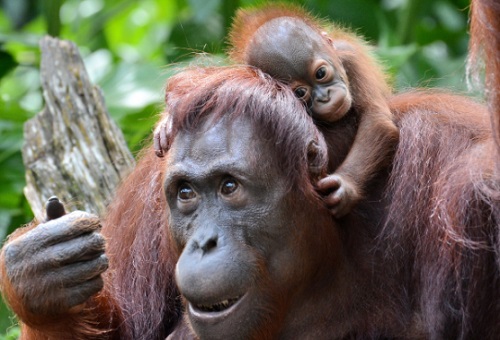

Interesting Facts
- The two species of orangutan, Sumatran Orangutan (pongo abelii) and Borneo Orangutan (pongo pygmaeus), genetically diverged about 1.5 million years ago.
- Orangutans have 32 teeth, the same amount as humans.
- It is believed that humans and apes had a common ancestor 15 million years ago.
- They share 97% of their DNA with humans.
- Orangutans are the only apes found outside Africa.
Name
- Common name: Sumatran Orangutan and Bornean Orangutan. From the Malay language “orangutan” which means “person of the forest”.
- Scientific name: Pongo abelii and Pongo pygmaeus

0
0
Population and Conservation Status
- The population of wild Sumatran Orangutans was estimated at 7,300 individuals in 2004. A new survey published in 2016 by Science Advances estimates a population of 14,613 individuals in the wild, doubling the previous estimate.
- The population of wild Bornean Orangutans is estimated at 54,500 individuals in the wild.
- Their habitat and population are threatened by logging, construction of roads and conversion to agricultural land.
- Both Bornean and Sumatran Orangutans are listed as Critically Endangered by the IUCN Red List of Threatened Species.
- They are also listed on Appendix I of CITES.
- The species is protected under Indonesian and Malaysian national law.
Distribution and Habitat
- Sumatran Orangutans:
- Pongo abielli live in the north part of the island of Sumatra, Indonesia at altitudes of 656 to 4,921 ft above sea level (200 to 1,500 m).
- They are almost exclusively arboreal and are found in forests, lowland swamps and mountain foothills near sources of water such as streams, rivers, lakes or swamps.
- Deforestation has fragmented its habitat which has experienced a decrease of 80% over the last 20 years.

- Bornean Orangutans:
- Pongo gymaeus live in the island of Borneo, Malaysia and Indonesia, at altitudes of up to 1,640 feet above sea level (500 m).
- They have an uneven distribution throughout the island, the species is absent from the southeast region. They are found in swampy hills and tropical rainforests.
- In the 1950s the habitat of Bornean Orangutans was 158,500 sq miles (255,000 km 2). By 2010 their habitat had decreased to 60,700 sq miles (97,726 km 2).

Physical Features
- Sumatran Orangutans can be distinguished from Bornean Orangutans in that they are slightly thinner, have longer and thicker pale red coats, longer faces and dark gray skin, white hair on face and groin and long beards on males and females.
- Orangutans have long arms, about twice as long as the length of their trunk, and short legs.
- Males are twice as heavier as females.
- Males weight 191 lb (87 kg) on average and females 81.5 lb (37 kg).
- Males are 54 in (1.4 m) and females 45 in (1.15 m) long on average
Behavior
- Orangutans climb using both hand and feet. Females are exclusively arboreal, males rarely descent to the ground.
- About half of their awake time is spent eating. They are nocturnal animals and sleep on arboreal nests that they build every night.
- Adult males are solitary. Females and young orangutans form social groups but they do not have a social structure like other apes. It has been observed that Sumatran Orangutans are more social than Bornean Orangutans.
- Males have larger home ranges than females. Males live on 500 to 4000 ha while females on 64 to 900 ha. Males protect their home range from other adult males but would share their territory with females and their young.
- Orangutans communicate by emitting vocalizations, body language and scent marking.
- Grooming is an important source of socialization.
- Their diet includes fruits, leaves, flowers, bark, honey, nuts, seeds and insects.
Reproduction
- Females reach sexual maturity at 7 to 8 years and males at 18 to 20.
- Mating occurs during rainy season, from December to May when fruit is abundant.
- Sumatran Orangutans have the longest inter birth interval of any ape population at 9.3 years while Bornean Orangutans reproduce on average every 6 to 8 years.
- Gestation lasts about 300 days.
- Males do not play a role in caring for their offspring. Females care for them until they are 9 years old.
Life Expectancy
- Orangutans are expected to live from 50 to 60 years.
Taxonomy
- Kingdon: Animalia
- Phylum: Chordata
- Clade: Synapsida
- Class: Mammalia
- Order: Primates
- Family: Honimidae
- Genus: Pongo
- Species: Pongo abelii, pongo pygmaeus
References and Further Research
- Science Advances – Land-cover changes predict steep declines for the Sumatran orangutan
- Journal of Human Evolution – Life Story of Wild Sumatran Orangutans (Pongo abelii)
- National Primate Research Center, University of Wisconsin, Madison – Pongo
- McDonnell Genome Institute at University of Washington – Genome: Pongo abelii
- Smithsonian National Zoological Park – Orangutan
- University of California San Diego – Orangutans
- IUCN Red List of Threatened Species – Pongo abelii
- IUCN Red List of Threatened Species – Pongo pygmaeus
- University of Michigan Museum of Zoology – Pongo abelii Sumatran Orangutan
- San Diego Zoo Global – Orangutan, Pongo pygmaeus, Pongo abelii
- Scientific American – Bornean Orangutan Now Critically Endangered
- The Animal Aging and Longevity Database