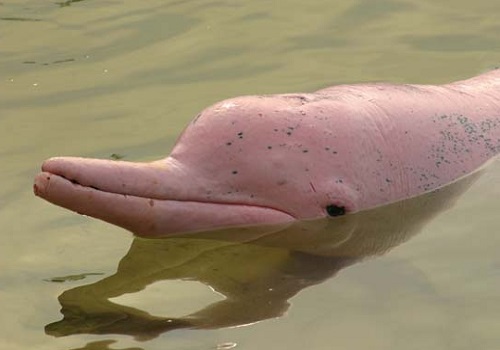

Name
- Common name: Amazon River dolphin, pink dolphin, boto, bufeo. The name dolphin originates from the Greek delphus meaning “womb”. It can be interpreted as “fish” with a “womb”.
- Scientific name: Inia geoffrensis. Inia derives from the Guarayos tribe in Bolivia.
Taxonomy
- Kingdom: Animalia
- Phylum: Chordata
- Class: Mammalia
- Order: Cetacea
- Family: Iniidae
- Genus: Inia
- Species: Inia geoffrensis
- Subspecies: Inia geoffrensis geoffrensis
- Subspecies: Inia geoffrensis humboldtiana
- Subspecies: Inia geoffrensis boliviensis
Distribution
- The Amazon River dolphin is distributed throughout the Amazon and Orinoco Rivers and their tributaries.
- Its distribution covers approximately 2.5 million sq miles (7 million sq km) in Bolivia, Peru, Brazil, Colombia, Ecuador and Venezuela.
- Inia geoffrensis geoffrensis – Central Amazon River Basin.
- Inia geoffrensis humboldtiana – Orinoco River Basin.
- Inia geoffrensis boliviensis – Upper Madeira River.

0
o
Habitat
- Pink dolphins inhabit tropical freshwater lakes, ponds, rivers, streams and flooded forest.
- During the dry season they are found in main rivers.
- During the rainy season they are found in smaller rivers, channels and flooded areas in addition to main rivers.
Physical Features
- The Amazon River dolphin is the largest of the river dolphins.
- They have short bristles on top of the long beak.
- Its body is extremely flexible as none of the cervical vertebrae are fused which allows them to flex and bend with ease when diving. It can bend its neck 90 degrees in all directions.
- Coloration depends on age. The young are grey. The coloration of adults depends on water temperature, clarity of water and geographical location. Those living in muddy waters tend to be pink and those living in clear water are gray with pink hue on the underside.
- Instead of dorsal fin the Amazon River dolphin has a hump on its back.
- They have long triangular flukes and large flippers.
- Male dolphins are called “bulls” and females “cows”. Young dolphins are called “calves”.
Size and Weight
- Males are larger and heavier than females. It is the only species of river dolphins where the male is larger than the female.
- Males weight an average of 339 lb (154 kg) and up to 456 lb (207 kg), while females weight an average of 220 lb (100 kg) with an upper range of 339 lb (154 kg).
- The average length of a male is 7.6 ft (2.32 m) with an upper range of 8.36 ft (2.55 m). Females can grow up to 7.15 (2.18 m) with an average length of 6.56 ft (2 m).
Behavior
- Seasonal migrations are related to flooding and availability of fish.
- These mammals are diurnal, more active during daytime.
- Pink dolphins are usually seen alone. Mothers with their calves remain together for 2 to 3 years. They congregate in feeding areas but then they disperse.
- A group of dolphins is called “school” or “pod”.
- They are curious and playful and are not shy to approach people.
- Pink dolphins have a flaccid melon on their foreheads, an organ used for echolocation. Dolphins make a sound, much like a click, that travels through water and when it bounces back it is processed by the melon. They can estimate the distance, shape and density of the object or prey.
- In captivity pink dolphins have been recorded making 10 distinct sounds including whistles, whimpers, squeaks, clicks and barks.
Reproduction
- Males reach reproductive maturity when they reach 6.5 ft (1.98 m) long. Females can reproduce when they are between 5.25 to 5.7 ft (1.6 to 1.75 m) long.
- Births happen between May and July when rivers reach their peak levels and water start receding.
- Gestation lasts 8.5 months and mothers give birth to a single calve that weighs about 31.5 in (80 cm).
- Females give birth every 15 to 36 months.
- Calves stay with their mothers for 2 to 3 years.
Diet
- Amazon River dolphins eat piranhas, river turtle, crab and a variety of fish.
Life Expectancy
- In captivity pink dolphins live from 10 to 26 years.
- Life expectancy in the wild is unknown.
Threats
- Increasing conflict with fishermen as pink dolphins accidentally get caught in fishing nets damaging them.
- Fishermen kill them because they are seen as competition for fish.
- Construction of hydroelectric dams alters river flow and the availability of fish.
- Deforestation and mining pollute and degrade their habitat.
Conservation Status
- Up to 1996 the IUCN listed the pink dolphin as a vulnerable species. Because of limited information on ecology, habitat, threats and population numbers it is now considered Data Deficient.
References and further research
⇒IUCN Red List of Threatened Species – Inia geoffrensis
⇒U.S. National Library of Medicine – The freshwater dolphin Inia geoffrensis geoffrensis produces high frequency whistles.
⇒The American Society of Mammalogists – Inia geoffrensis
⇒ITIS Report – Taxonomy of Inia geoffrensis
⇒World Register of Marine Species
⇒University of Michigan Museum of Zoology – Inia geoffrensis
⇒American Cetacean Society – Boto (Amazon River Dolphin) Inia geoffrensis